Photo · Cairo, Egypt
The Pigeon Racers of Cairo
Written by Liam Kozak ·
Photographs by Ethan Jones ·
July 8, 2026
Ethan and I are crammed in the back of a tuk-tuk, shoulder to shoulder in the most suffocating pocket of an already airless city. We get out of the tuk-tuk for a short moment and are greeted warmly for the first time all day by a man who doesn't mind us taking photos of him at work with his young son. In the building behind them, a teenage girl and her mother are up to their knees in garbage bags, sorting through with gloves on. After just seconds we're encouraged to get back in the tuk-tuk before the locals get annoyed. I get it, but I can't help feeling restricted here. And a little bored.
I was bored of Garbage City before I even arrived. It's overexposed. It's used for content by Instagram travel-influencers to portray their vacation as meaningful "work" with unnecessary ChatGPT captions meant to posture them as "explorers" or "travelers" or, and this is the worst one, "journalists." But I wanted to see it for myself.
Known locally as Manshiyat Naser, Garbage City is home to an estimated 60,000 to 70,000 people — most of whom are Coptic Christians belonging to the community known as the zabbaleen, which translates literally to "garbage people." Over decades, the zabbaleen built an informal but astonishingly efficient recycling system by collecting waste door-to-door from the many neighborhoods of Cairo and bringing them back to Manshiyat Naser to sort by hand. Crosses are abundant throughout Garbage City, adorning buildings and hanging from electrical wires.
This area, defined from the outside by trash, is a spiritual anchor of Christian values that seem to have long-been forgotten by the global Christian population: humility without spectacle, dignity in the lowest labor, and stubborn devotion to serving what the rest of the world throws away. I understand why it's important but I'm not all that interested in saying what's already been said.
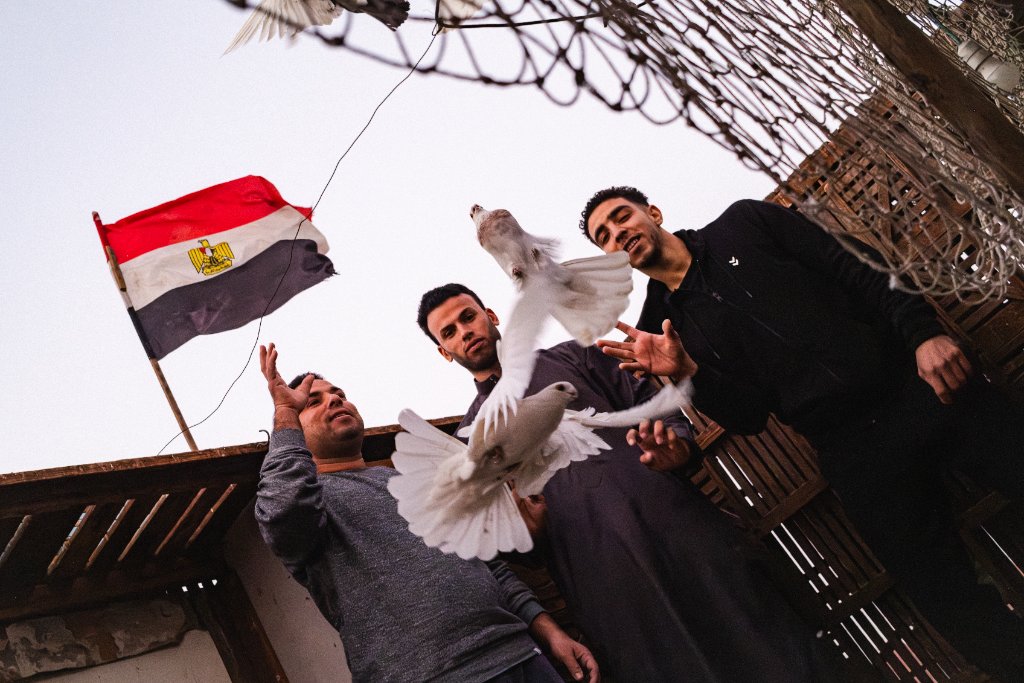
Mustafa, our rough-around-the-edges local tour guide who seemingly knows every person in Egypt, takes us deeper into Garbage City, and we're met by a group of men who welcome us with smiles and beckon us into their home. This way, says Mustafa, we'll be able to see Garbage City from the roof and get a better view.
We head up several flights of stairs until we get to the roof. Ducks everywhere. Stepping over duck shit, we walk over to a ladder and make our way up several stories of makeshift, wobbly, wooden scaffolding that leaves our hands splintered.
Every step higher feels more free than the last. Away from the claustrophobia of the narrow and cluttered streets that Cairo's composed of. Away from the pungent odor seeping in and out of every surface. Away from the resigned faces of destitution. Away from all the work there is to do that keeps your hands busy and your head down. Away from the ground, and the shame that keeps your eyes glued to it. Into the sky. I breathe in. It's the freshest air I've tasted since arriving in Cairo.
I take a long look at Garbage City from this view. Certainly garbage everywhere. I almost don't notice the large buildings that speckle the skyline in front of me, or that they're identical to the one we're on now. I turn around. What the hell's up with all the birds? The men, who descend in age from late twenties all the way down to a ten-year-old boy, are showing off various pigeons with the passion of Wall Street jewelers showing off different diamond cuts. Now this is interesting.
A game played in the sky
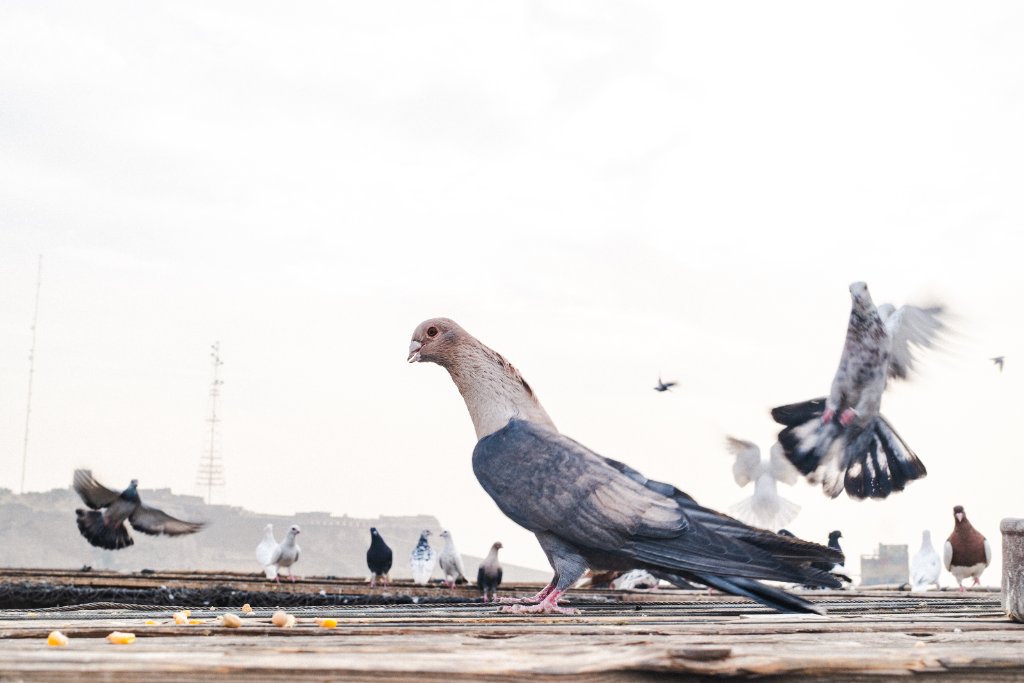
Pigeon-keeping in Cairo, says Mustafa, is as much a hobby as it is heritage. These boys learn from their fathers, who learned from theirs. The birds, we're told, are trained to fly in coordinated flocks, circling high above the city in tight formations before swooping back down to their rooftop coops.
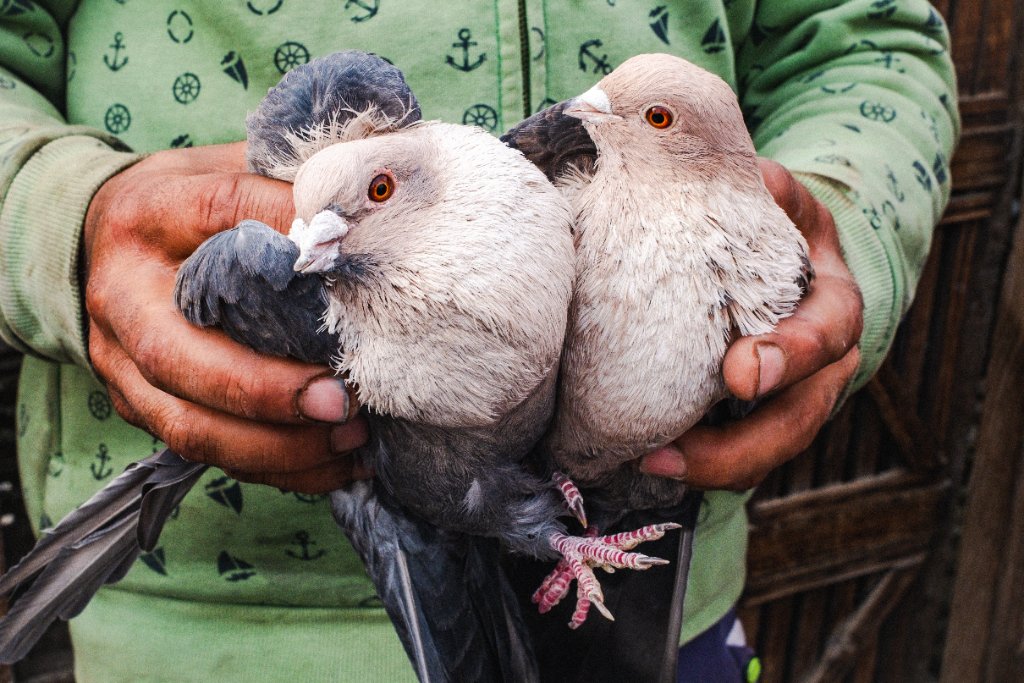
"When a bird is caught, it's mated with another bird. No matter where they are, they will always return to their family. That is where they know their home."
Entire neighborhoods compete informally, each roof marked by its wooden pigeon tower. Some are not much more than scrap-wood shacks, but others are ornate geometric structures reminiscent of miniature minarets. I'm struggling to understand the purpose of it, and then the game reveals itself.
From behind, we hear a trap spring and a bird's wings flap in futile resistance. It lies beneath a circular rope net spread across warped, sun-bleached planks. Its head pokes through the lattice, eyes wide and alert, body still but humming. The main man in charge goes to the trap, cigarette hanging from his mouth, splays his hands across the net like steadying a fragile instrument.
Then comes the lift. He slides a hand beneath the net and pulls the pigeon free, gripping it confidently around the body. Its wings explode open in a sudden burst of silver-gray feathers. For a second it looks triumphant but it isn't going anywhere. His thumb presses along its breastbone, fingers cupping its ribs with the muscle memory of someone raised in this choreography. The limestone cliffs loom behind him like an ancient coliseum. This bird made a mistake. It followed the wrong flock down.
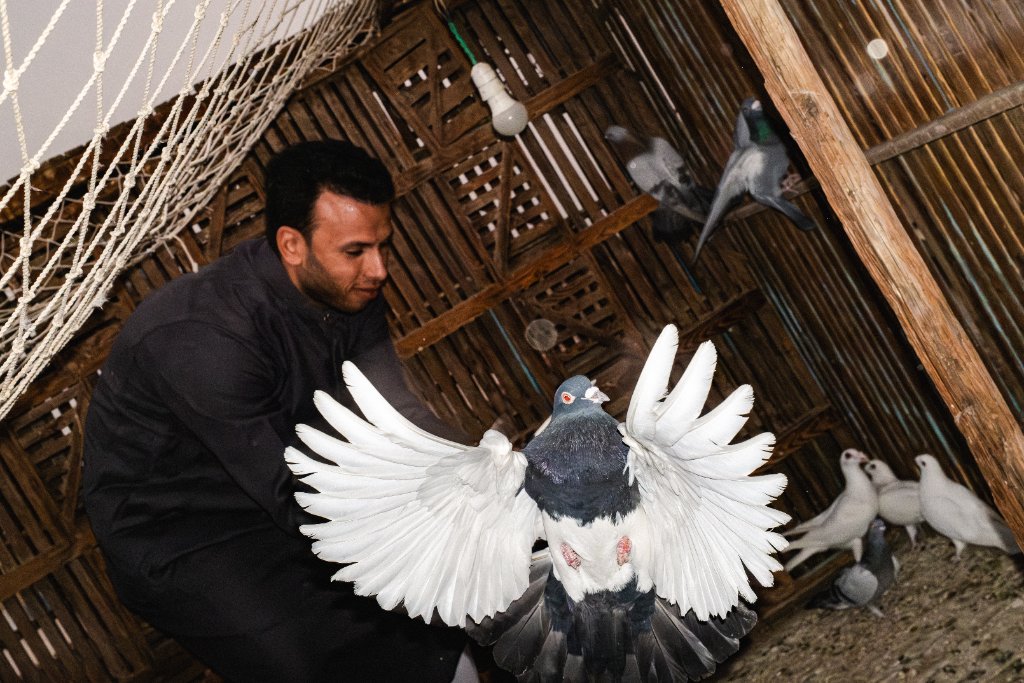
And that's the game: release your flock, let them mingle with others in the sky, try to lure rival birds back down to your own coop. Gradually, you can build a larger and more prized flock this way. It's a combination of skill, patience, and luck. The practice is especially common in dense working-class districts where rooftops are the only open space available.
I'm mesmerized by the nature of these aerial war games. Obsession for the sake of obsession. Unseriousness in the face of dire circumstances. The freedom to play above the confines of an increasingly overburdened city, and the space to breathe in a congested metropolis where the only thing harder to find than money is elbow-room.
Abusir, and a flag in slow arcs
On the other side of town, in a downtrodden neighborhood called Abusir, we're brought to a large network of more closely-connected pigeon towers. Hummas and Ahmed, pigeon fanciers (as they're called), greet us out front with a group of boys. They usher us up the stairs in a similar fashion as the coop in Garbage City, with large smiles stretching ear-to-ear and excitement at the thought of someone taking interest in their "little hobby," as they call it.
Here, in a more typical and working-class neighborhood like Abusir, I'm not distracted by the layers of a standard Garbage City building. With each flight of stairs in Abusir I'm allowed the privilege of peering into multi-family homes living within the standard Egyptian circumstances of poverty. Prayer mats worn from use. Crumbling walls that know better than to expect any upkeep or renovation anytime soon. Unamused faces on the denizens of the building, tired from decades of living whatever life they must.
Faces with expressions on them that couldn't be further from the expressions of Hummas, Ahmed, and the rest of the pigeon coop entourage. From my observation, the pigeon coops are most dominant in places like Garbage City and Abusir where opportunity is scarce. Maybe they have just enough time on their hands to play, or maybe it's the therapeutic break they need from a densely-packed work week. Regardless, the pigeon people are the happiest in each neighborhood I've visited.
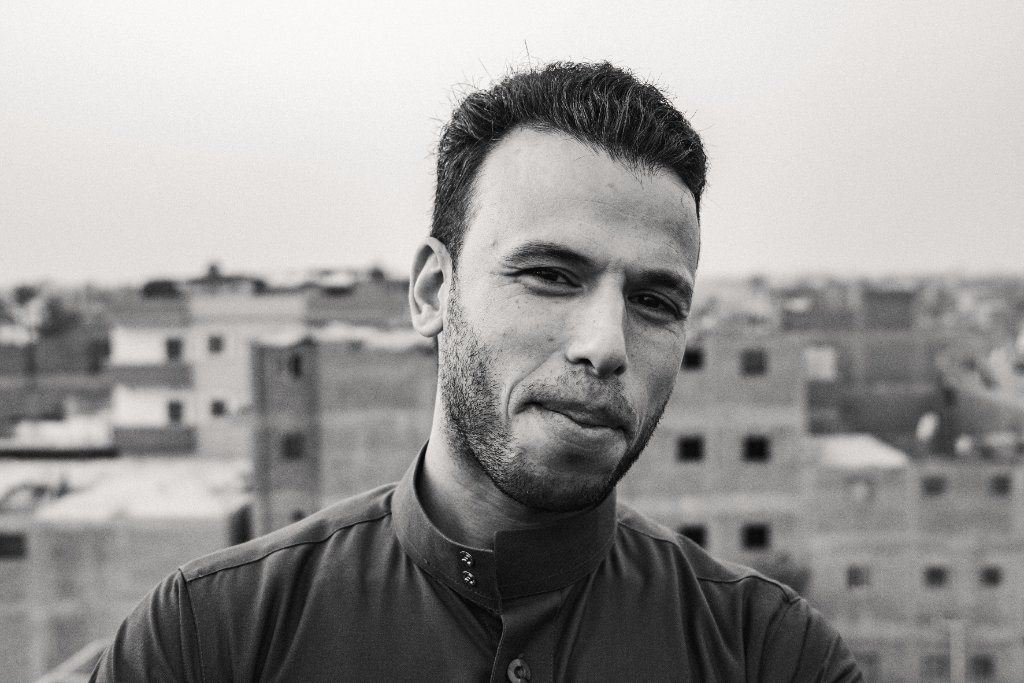
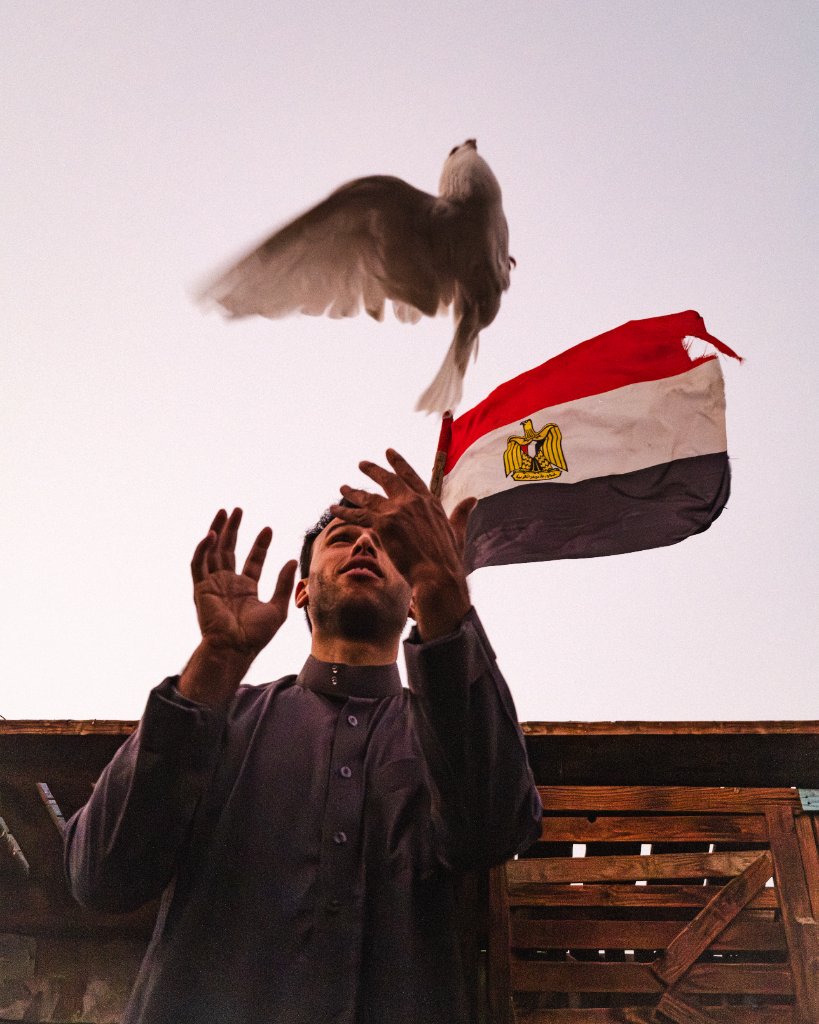
At the coop up top, Hummas shows off the full range of control he commands over his fleet. He slides open three panels. For a moment, nothing happens. Ephemeral silence, only interrupted by intermittent coos. Then, an eruption.
A dozen or more pigeons explode into the sky, wings beating frantically, before organizing themselves into a proper flock. They climb quickly, cutting upwards through the warm air above Abusir until they're circling high over the rooftops. From the ground their choreography might look random, but up here you can see the system: tight, synchronized loops that widen and contract like the lungs of a living organism. The flock doesn't stray too far. They orbit the coop like a satellite that knows exactly where its gravity is. I wonder if they feel the same up there that their owners feel when they reach the top of their tower. Free from the shackles of their packed cages, if only for the moment.
Hummas watches them the way a shepherd watches sheep. Calmly and patiently observing their movement, smiling slightly with the knowledge of their inevitable return. I wonder if that's how the Egyptian police look at the pigeon fanciers, grinning knowing that they'll have to come down from their towers eventually and get back to the rat race.
"They understand more than words."
When Hummas decides it's time for the pigeons to come back, he raises a small Egyptian flag tied to a stick and begins to wave it in slow, rhythmic arcs. The flock compresses. Wide circles tighten into smaller ones, the birds spiraling downwards in coordinated layers of brown, black, gray, and white. One by one they break formation and drop towards the roof, wings folding as they land back on the wooden planks of the coop.
Ahmed points at a pigeon tower a few blocks away and tells us that one's his. It's situated directly next to two smaller ones. I ask if we can go and check it out. He happily obliges.
Walking out of the building where Hummas' tower is, a few women yell from the second floor and ask us to stop. They're yelling in Arabic, and there's so much going on that our translator doesn't have much time to explain. A woman rushes from the window to her door, then down the stairs, and then into the alley where she brings out a baby. She insists, almost begs, me to hold her baby and take a picture with it. That's what Mustafa, our translator, said. I held the baby and took the picture. I'm unsure if they thought I was a celebrity or someone more important. Mustafa didn't explain, and she only spoke in Arabic so I couldn't understand her. She beamed, almost with tears in her eyes, and thanked me. It was important but I don't understand why.
Ahmed's coop allows us to peer into the neighboring adjacent coops. One is being maintained in some way by a solo man, presumably doing some upkeep that I'm not familiar with. The other one is being enjoyed by a man and his two children. The kids are climbing all up the coop while the father pulls out pigeons and shows them to his children. From father to son, and so on until the end of time I imagine.
Stepping back out onto the street of Abusir, and away from the feather-filled towers that decorate the skyline, I still don't know exactly what interested me so much about the pigeon coop wars of Cairo. Simple oddity? The ability to play games while living in abject poverty? The patrilineal inheritance of it? Was it the camaraderie and competition between men taking place in the sky? I'm still not entirely sure. I leave with a lingering feeling that this is important but I don't understand why.